CoCo 1.2.0 · the CoCo Research flagship

Your editor, arguing with itself before anything ships.

Each of the 389 requires a live, checkable source. Then 185 skills ship what they decided.

Your call

100% local. No telemetry.

The board argues before CoCo answers.

Ask a hard question and CoCo convenes the experts who actually disagree about it. They argue in rounds, positions move, and dissent is recorded by name rather than averaged away. You get the reasoning, the split, and who held which line.
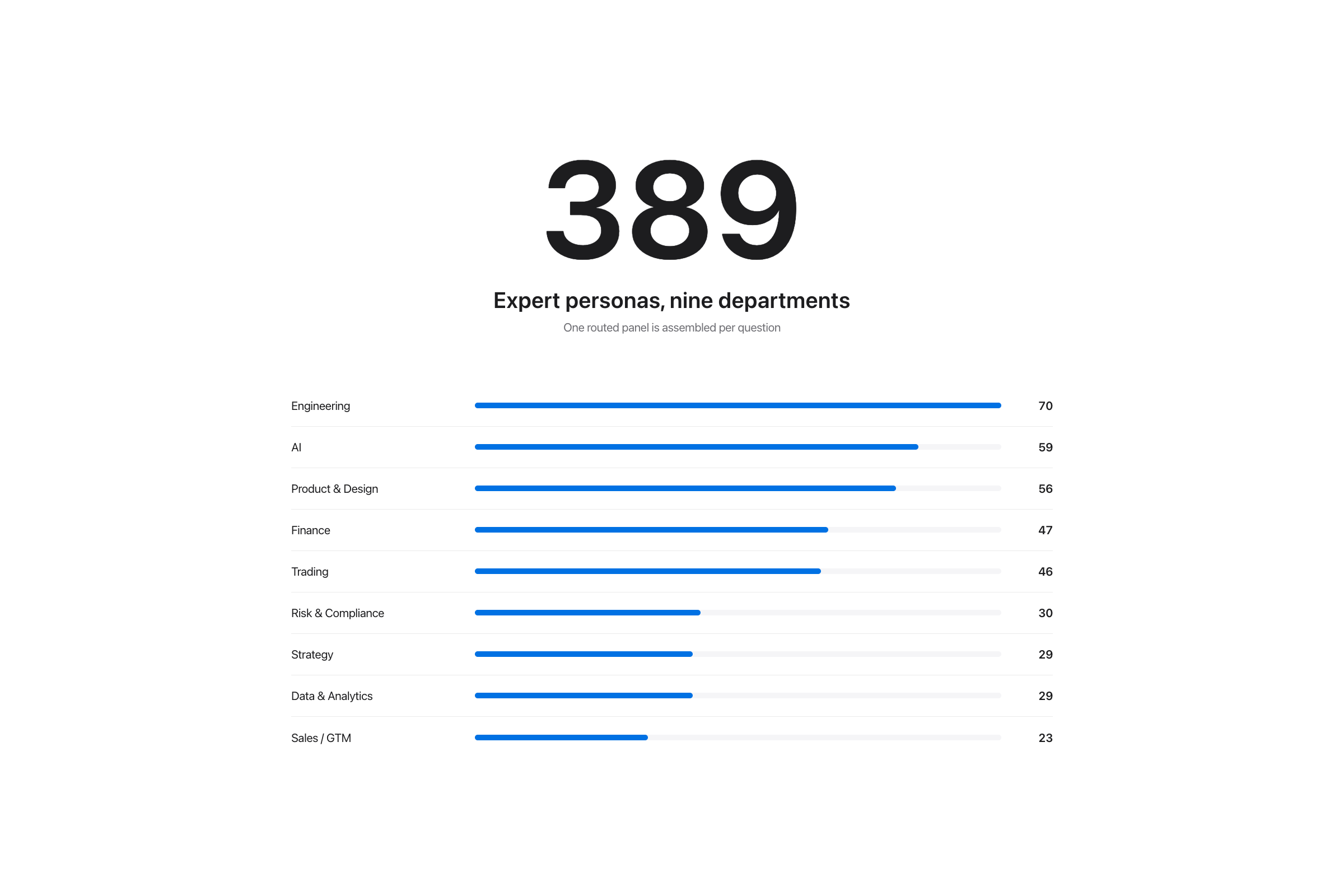
389 expert personas across nine departments, bar length proportional to each department's real headcount
389 experts, broken out by department. Engineering carries the largest seat count, at 70.
A real /SI-Decide run. The panel is routed, not fixed, and dissent is kept, not averaged away.

389

Expert personas

Each requires a live, checkable source link. Quotes are illustrative reconstructions, not verbatim; see the disclaimer.

9

Departments

Engineering, AI, product and design, finance, trading, risk and compliance, strategy, data, sales and go-to-market.

280

Commands

38 core, plus 242 generated locally at install from the team registries.

34

Agents

Specialists that carry the decision into code, review it, and verify the result.
185 skills. One instruction set each.

Not prompt snippets. Every skill carries state management, verification logic and error handling, so the work survives being handed between sessions and between tools.

Orchestrate

Teams

A four-layer role pipeline behind /team: research, execute, review, synthesize. It ships with the core install; there is nothing to enable.

Remember

Brain

Six skills that keep durable project knowledge, so context outlives the session it was learned in.

Travel

Any editor

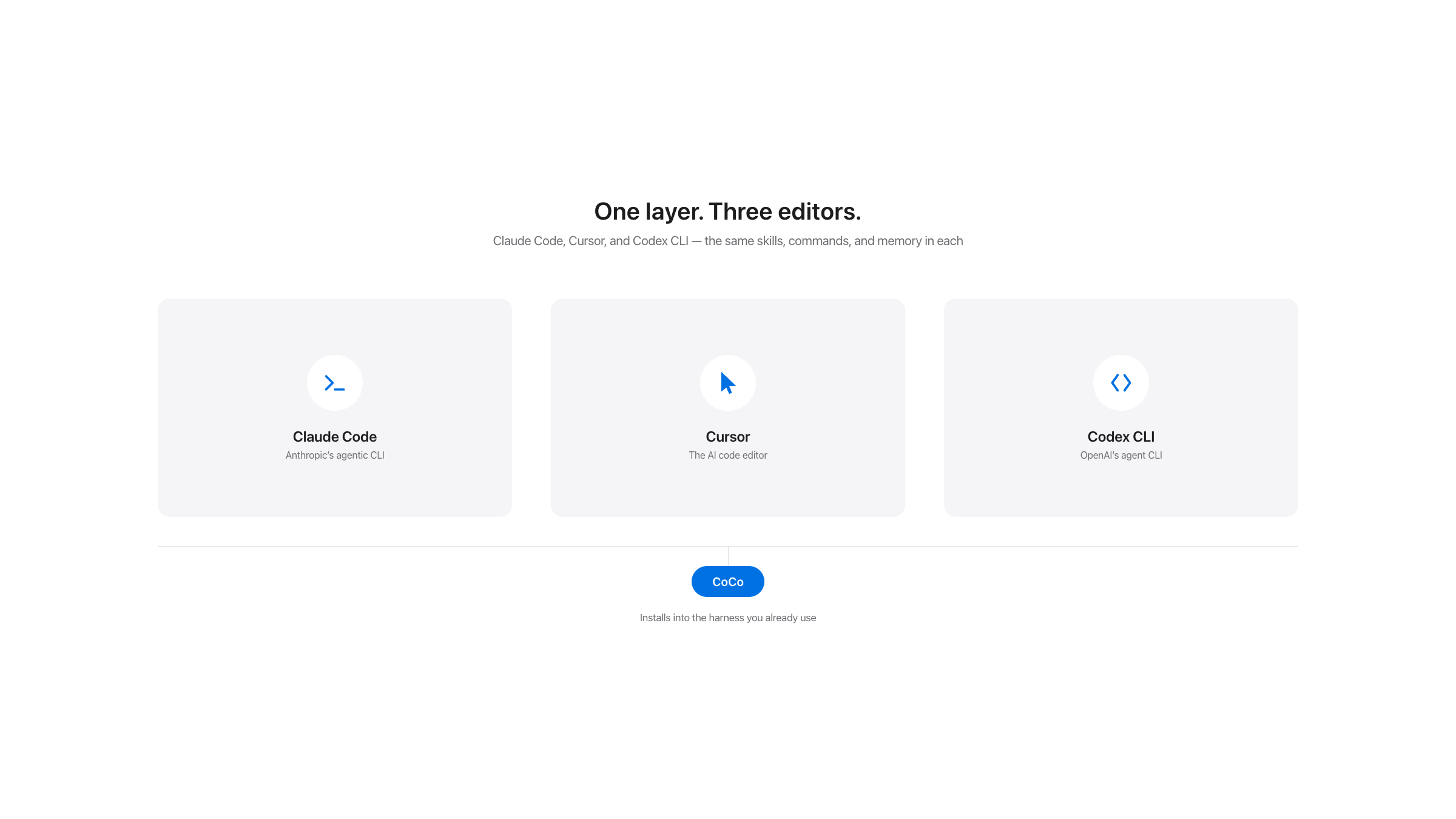
Claude Code, Cursor, and Codex, from one install. The adapter changes; the skills do not.

Claude Code, Cursor, and Codex CLI shown as three identical cards, unified under one CoCo layer
One layer. It installs into Claude Code, Cursor, or Codex CLI.

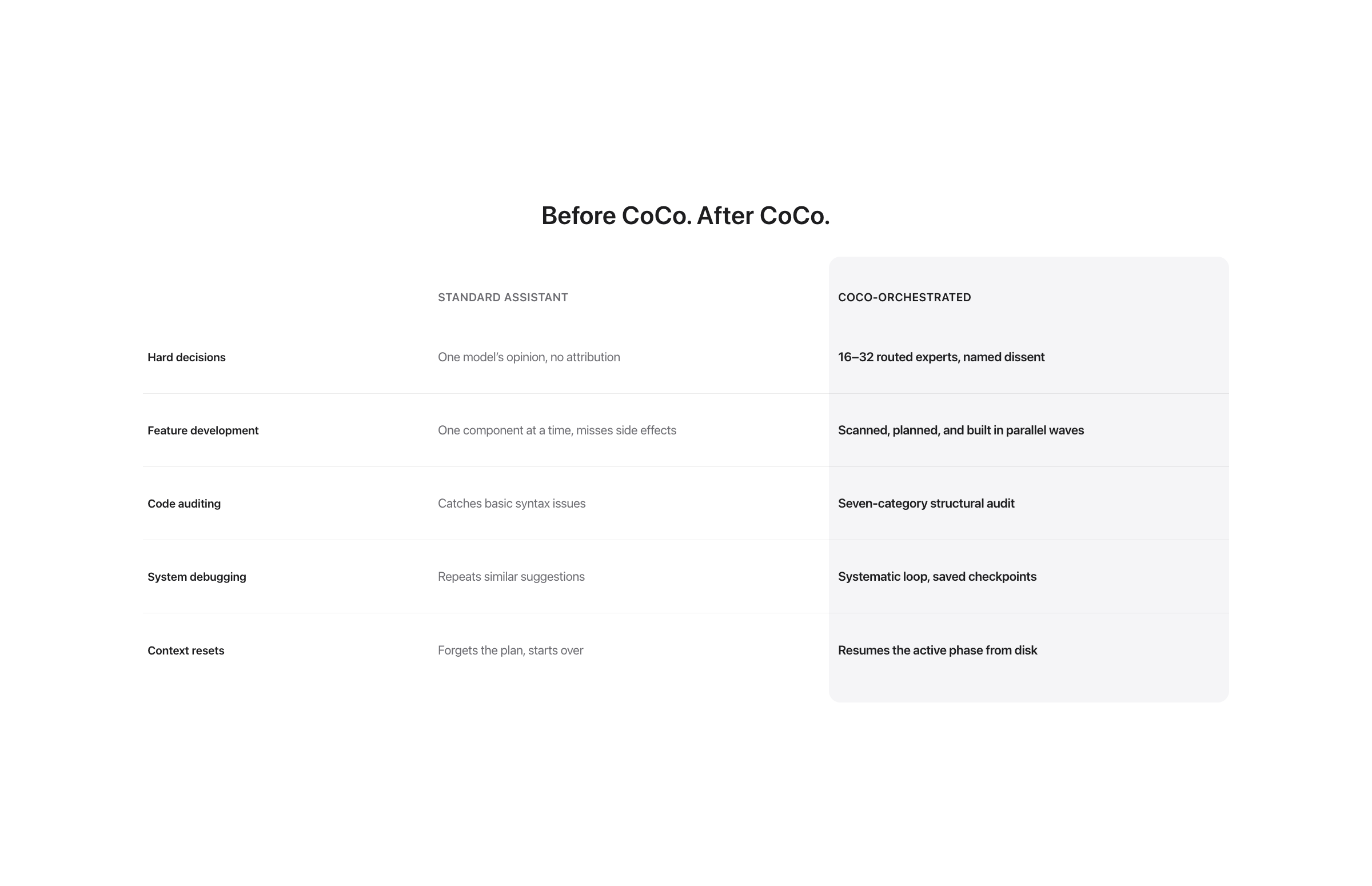
The same five situations, with a board behind them.

Nothing here is hypothetical. Every row is a real workflow, compared with and without a routed panel and a build pipeline behind it.

A five-row comparison of a standard AI assistant versus a CoCo-orchestrated workspace, across hard decisions, feature development, code auditing, system debugging, and context resets
Before CoCo and after, across five real workflows.

Ninety seconds. Then it's yours.

One command. It clones, shows you the exact commit you're about to run, and waits for you to say yes. Runs on the model and editor you already have: Claude Code, Cursor, or Codex. Your keys never leave your machine.

Step one

Run it

bash <(curl -fsSL https://raw.githubusercontent.com/coco-research/coco/main/bin/coco-bootstrap.sh)

Step two

Confirm the commit

CoCo prints the hash, date and message, then pauses. Nothing executes until you approve it.

Step three

Convene the board

/SI-Decide "should we migrate to Postgres?"
It asks before it does something big. The Super Intelligence bundle needs an explicit yes.

By the numbers

Version1.2.0
Skills185 in the repository: 70 core, plus 68 GSD, 20 HyperFrames, 9 Super Intelligence, 6 Brain, 5 Cursor, 4 M0 and 3 Cognee. The Claude Code adapter installs 171 of them; the 9 Super Intelligence skills are reached through their generated commands rather than installed as skill files, and 5 are Cursor-only.
Commands280. 38 core, plus 242 generated locally at install.
Agents34. 10 core, plus 24 in the GSD bundle.
Personas389 across 9 departments, each behind an evidence-validation gate.
EditorsClaude Code, Cursor, Codex, and any AGENTS.md-compatible tool.
ExecutionEntirely local. No telemetry, and no command files transmitted or stored remotely.
InstallRoughly 90 seconds, with a fail-closed commit confirmation before anything runs.
Bundles6 opt-in system bundles: GSD (68 skills, 24 agents), HyperFrames (20 skills), Super Intelligence (9 skills), Brain (6 skills), M0 (4 skills), and Cognee (3 skills). Enabled with --systems.
LicenceOpen core. MIT core, with the Super Intelligence system licensed separately and kept proprietary.